
Plan a Rail Trip Day with a Map: Station, Base and Nearby Stops
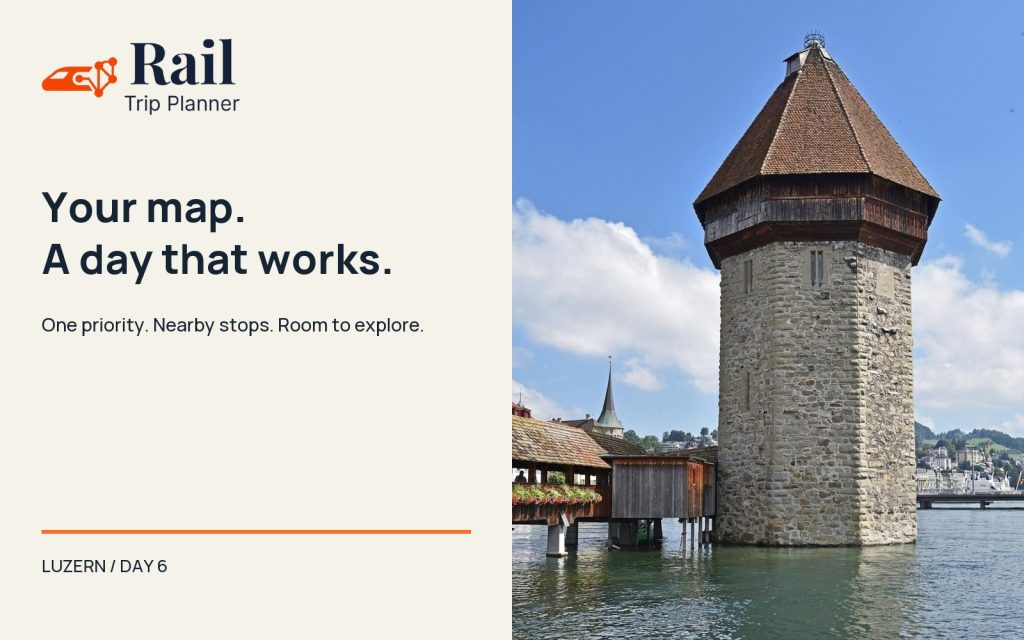
Twenty saved places can make a trip look exciting and a morning surprisingly difficult. Which one comes first? Can you walk between them? Will you still have time to get back for your train? A useful day plan connects a few places to the time and energy you actually have.
Here is a method you can use in any city: locate your station and accommodation, choose one priority, group nearby stops, check the real journey between them and leave room to change your mind. We will apply it to Day 6 in our public Paris–Lucerne–Milan sample, rather than inventing another itinerary.
Start with the day you really have
A full day in one city is different from an arrival day. Before opening your saved places, write down your fixed commitments: arrival or departure, check-in arrangements, luggage storage and any timed ticket you already hold. If a train leaves that afternoon, the journey back to the station belongs in the plan from the start.
In the sample, Day 5 is the move from Paris to Lucerne. Day 6 is a sightseeing day while staying in Lucerne, with no intercity transfer built into it. That distinction is why a bridge, old-town walk and possible wall visit make sense here. They are not three appointments to squeeze in after arriving from Paris.
The sample is an illustrative plan for two fictional travellers, with flexible dates in the second half of May 2027 and no confirmed bookings. It demonstrates a method; it does not establish future availability, accommodation prices or an accessible route for every traveller.
Put the station and your base on the map first
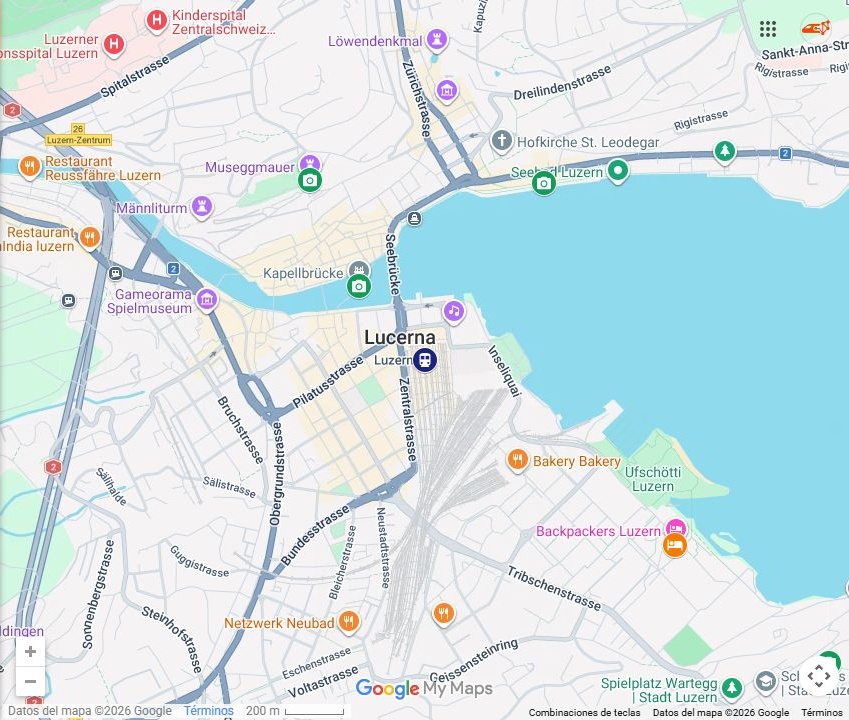
Open the public trip map. Its layers separate stations, recommended accommodation and sights. In Lucerne, find Luzern station, then the accommodation you are actually considering. A suggested hostel pin is not a reservation: use your own confirmed address once you have one.
This gives the day a beginning and an end. Ask whether you are leaving luggage at the hostel, returning there for a rest or going straight to the station. A place can look close to a landmark but still require extra walking when you include the journey from your room and back.
Choose one priority, then group nearby places
The sample's Day 6 priority is the connected walk around Kapellbrücke, the Chapel Bridge, and the old town. The map also includes Museggmauer, the Musegg Wall. These are the relevant pins for this day; the lakeside towards Tribschen belongs to Day 7, and the optional Bürgenstock outing belongs to Day 8.
That is the useful editing decision: keep a coherent local group instead of treating every Lucerne pin as something to visit today. The bridge and riverfront can anchor the morning, followed by an unhurried old-town walk. Musegg is a conditional afternoon option, with free time afterwards. You do not need to fill every gap.
Decide which stop matters most to you. If bridge photographs are the reason for the day, give them space. If climbing the wall is your priority, check its access first and simplify the rest. A saved place should earn its time, rather than becoming compulsory just because it is on the map.
Check paths, entrances and opening days
A pin map is not a verified walking route. It shows where places are, not whether a particular entrance, crossing or path is suitable. Open walking directions between the stops, check the actual entrance and consider steps, slopes, luggage and your own pace. A straight connector is not evidence of a public path or railway alignment.
Musegg is the important constraint in this example. The operator currently lists seasonal public access from 1 April through 1 November, normally 08:00–19:00, with night and snow closures. Check the official opening and access information for your date. This is not a guarantee for May 2027, and a winter traveller should not reuse the sample as though the towers were open.
Do not turn a map estimate into a timetable. A routing estimate usually does not include your photographs, queues, getting lost, lunch or a tired afternoon. If a visit needs a ticket, verify its product, entrance and slot separately before fixing the order around it.
Turn the cluster into a simple day plan
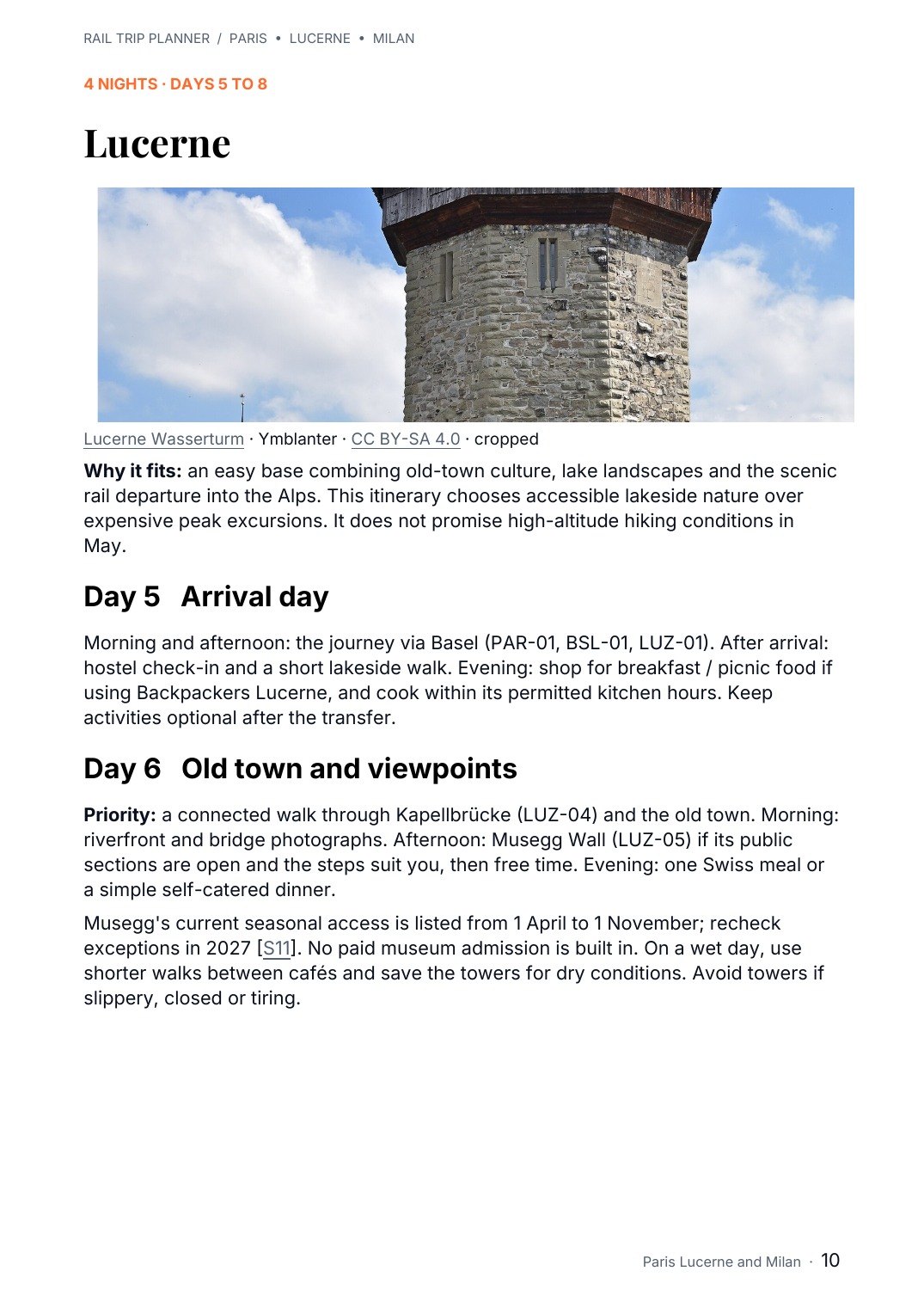
Page 10 of the public sample PDF already contains the Day 6 plan. Use it alongside the map: the map answers where; the written plan answers what matters, what is optional and when to stop.
| Part of the day | Main idea | What to keep flexible |
|---|---|---|
| Before leaving | Check weather, wall access and your starting address | Shorten the day if conditions or energy change |
| Morning | Riverfront, Chapel Bridge and the old town | Time for photographs and pauses |
| Lunch | Eat before deciding on the afternoon | No extra attraction needed to fill the break |
| Afternoon | Musegg only if open and suitable | Skip the steps; keep free time instead |
| Evening | Return to your base and have dinner | A simple meal or self-catering, as the sample suggests |
These are planning blocks, not booked time slots. There is no invented departure time, restaurant booking or precise walking duration. Add exact times only where your actual reservations and checked transport require them.
Leave room for weather, meals and the return
The sample's wet-weather alternative is deliberately small: shorter walks between cafés, saving towers for dry conditions and avoiding slippery or tiring steps. It does not require adding a museum ticket or travelling to another town. A fallback works best when it removes pressure rather than creating a second complicated itinerary.
Keep lunch and a return journey visible in the plan, even when neither is booked. On a transfer day, work backwards from the train you intend to take and include luggage collection and reaching the correct platform. The margin depends on your station, ticket, luggage and mobility; one universal number would be misleading.
A five-question check before you leave
- Do I know my real starting point and where I need to finish?
- Which one visit is the priority, and which can disappear?
- Have I checked entrances, opening days and walking directions?
- Is there room for food, photographs, rest and the return?
- What will I shorten if weather or energy changes?
If those answers are clear, you have something more useful than a long list of pins. Keep the remaining saved places for another day.
See the map and the plan working together
You can explore the sample itinerary to see the PDF and map in context. Rail Trip Planner organises train trips around Europe into a personalised written itinerary and trip map. The sample shows the format; your route, priorities and practical constraints determine your own plan.
Photography: Ymblanter, Lucerne Wasserturm, CC BY-SA 4.0, cropped. Map: Google My Maps; map data © Google. PDF and editorial example: Rail Trip Planner. CC BY-SA 4.0.
 First Train Trip in Europe: 14 Questions Answered
 Poland by Train: A Two-Week Route Through Four Cities
 Interrail Pass vs Individual Tickets: How to Compare a Trip with Few Train Days