
Packing for a Winter Interrail Trip: A Bag You Can Actually Move
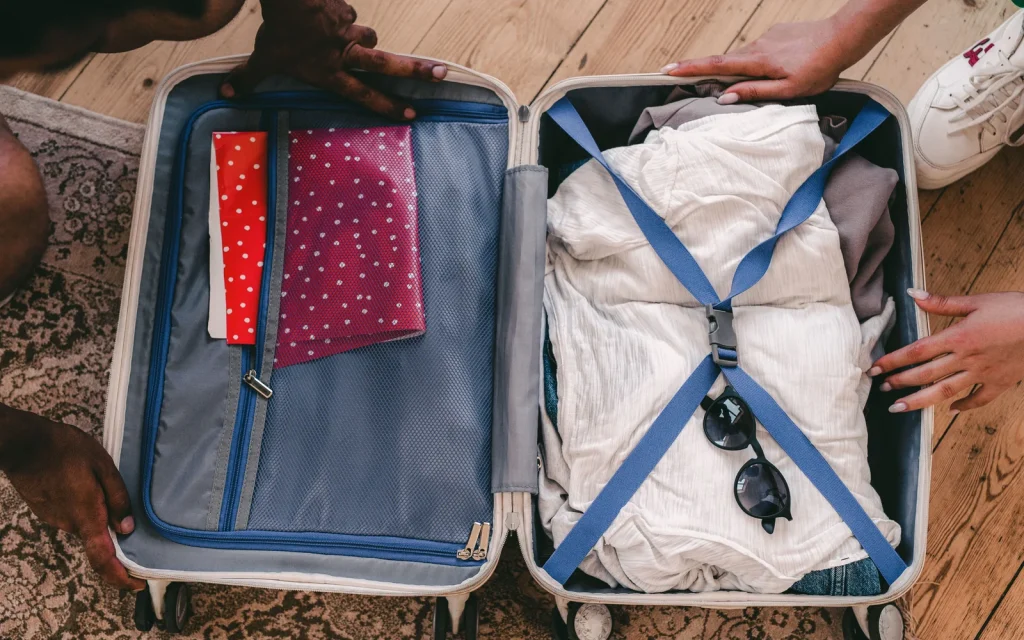
Pack for the journey between your rooms, not just the days inside them. A useful winter Interrail bag holds layers you can combine, clothes for a realistic wash cycle and the things you need on the train—while remaining manageable on your actual station transfers. There is no universal winning backpack, suitcase size or weight.
Start with the coldest part of your route, your mobility and the luggage rules of each train. Then test the bag fully packed, including the coat, food and water you might need to carry. If the plan depends on somebody unexpectedly lifting it for you, change the load or arrange appropriate help before travelling.
This guide uses a nine-day city trip with laundry on the evening of day four as an adaptable example. The quantities are a planning suggestion, not a rule: your weather, clothing size, access needs, activities and laundry arrangements may require a different load.
In this guide: Choose the bag · Build your layers · Packing list · Plan the wash · Keep essentials accessible · Train rules · Test the journey
1. Choose the bag around your transfers
A suitcase can suit someone who prefers to roll their load rather than wear it. A backpack can suit someone who wants their hands free and is comfortable carrying it. Neither choice removes the need to check the route from station to accommodation, the boarding arrangement and somewhere suitable to stow the bag.
| Consider | What to test | What might change the choice |
|---|---|---|
| Rolling suitcase | Steering, turning and stopping it with your smaller bag as well. | Uneven surfaces, kerbs, distance to the accommodation and any section where it cannot be rolled. |
| Backpack | Putting it on, taking it off and carrying the packed load comfortably. | Your back and shoulders, balance, duration of carrying and ability to reach its contents. |
| Your full setup | Main bag, day bag, coat and anything attached to the outside, together. | Mobility aids, travelling with children, a companion’s agreed help and the assistance actually available. |
Choose volume after laying out the kit. Litres describe capacity, not how manageable a bag will feel when full. Compression can make clothes smaller; it does not remove their weight. Leave usable space for your coat when the carriage is warm and for the ordinary things you collect during a travel day.
Stairs are not a qualification for rail travel. If you need a step-free route or boarding assistance, check the relevant stations and operator in advance. Confirm what help covers, any booking requirements and whether luggage assistance is included. Do not treat station assistance as an unlimited porter service.
2. Build a small set of layers that work together
“European winter” is not one temperature. Check the forecast for each stop close to departure, including how long you expect to be outside. A coastal city, a cold inland evening and a mountain day trip can need different clothing even on the same holiday.
A top you are comfortable wearing and washing. Add a thermal layer if your conditions and preferences call for it.
A jumper, fleece or other warm layer. Choose pieces that fit together without restricting movement.
A coat or outer layer suitable for the expected wind and rain. Check what your existing clothing can actually handle.
These are functions, not a requirement to buy three new garments. Your winter coat may already provide both warmth and weather protection. Try the complete outfit before leaving, then check that you can remove a layer easily on a heated train.
A hat, gloves and scarf or neck warmer can be easier to manage than a second bulky coat. Keep them reachable when leaving a warm carriage. If an activity needs specialist clothing, plan that separately rather than assuming a general city kit is enough.
3. An adaptable nine-day packing list
Example assumptions: ordinary city visits, one main bag and a small accessible bag, clothes reworn when appropriate, and a usable washer and drying arrangement on day four. No skiing, remote hiking or dress-code event. Start with what you already own.
Wear on the first travel day: one next-to-skin top, one warm layer, one pair of trousers, underwear, socks and your main walking shoes. Wear or carry the outerwear and winter accessories you need for that day.
| Pack in addition | Example starting quantity | Adjust it when… |
|---|---|---|
| Next-to-skin tops | 3 | You need a fresh top more often, or the fabric cannot be washed and dried in the available time. |
| Underwear and socks | 5 of each | Your wash interval is longer. Including the worn set, this gives a four-day rotation plus two spares. |
| Trousers | 1 spare pair | You have an activity or clothing need that the two pairs cannot cover. |
| Warm layer | 1 additional layer if useful | Your worn layer is sufficient, or the forecast calls for more insulation. Avoid duplicates with no different use. |
| Thermal base layer | 1 set if needed | The coldest days, your comfort or time outdoors make it useful. It is not compulsory for every winter city break. |
| Sleepwear | 1 set | Your accommodation or personal needs require something different. |
| Toiletries and personal essentials | A compact kit for your trip | You need particular products or equipment. Keep essential personal items rather than cutting them to meet an arbitrary bag target. |
| Electronics | Phone, necessary cables, charger and relevant plug adapter | You genuinely need a laptop, camera or other device. Count each device’s charger and carrying space too. |
| Small practical items | Reusable bottle, laundry bag and suitable rain protection | Your accommodation provides something, or the route needs a different solution. |
The extra underwear and socks give a little margin, not permission to leave laundry unresolved. On day four, keep a clean outfit to wear while the used clothes are washed and dried. For a nine-day trip, the same rotation can cover the remaining days after the wash; for ten days, add a further wash, enough additional changes or another realistic arrangement.
Footwear can consume more space than several tops. One pair of already comfortable walking shoes with a sole suited to your expected surfaces may cover the city trip. Decide whether a second pair has a specific job—such as required indoor footwear—instead of packing it automatically. No shoe makes every icy or wet surface safe; adapt your plans to the conditions.
4. Put laundry in the plan before removing clothes
“I’ll wash something somewhere” is not a laundry arrangement. Find a facility you can use at your chosen base, check its access and opening hours, and allow time for both washing and drying. Put the wash on an evening when you are staying in the same place, rather than immediately before checking out.
A verifiable example is MEININGER Hotel Berlin East Side Gallery’s self-service laundry. Its official help page lists a washer and dryer for guests, a fee including detergent, and access tied to the guest kitchen’s opening hours. It does not offer a laundry service. This illustrates what to check; it is not a room recommendation or confirmation of machine availability for your trip.
- Access: is the facility for guests only, and can you use it at the time you intend?
- Cost and operation: check current payment methods, detergent, cycle length and dryer access.
- Clothing care: read your garments’ labels. A dryer being present does not mean all your clothing can go in it.
- Fallback: identify another usable facility or carry enough extra changes for the next opportunity. Do not assume thick clothes will dry overnight in your room.
Keep dirty or damp items separate from clean clothing, and deal with them at the next suitable opportunity. A separate bag organises the problem; it does not dry its contents. On Christmas or New Year trips, check laundry access for the exact date alongside the other holiday arrival-day arrangements.
5. Pack for access, not just for a tidy photograph
Your ticket should not require opening the entire suitcase in a station queue. Keep the things you will use during the journey in a small bag or pocket you can reach without unpacking your main load.
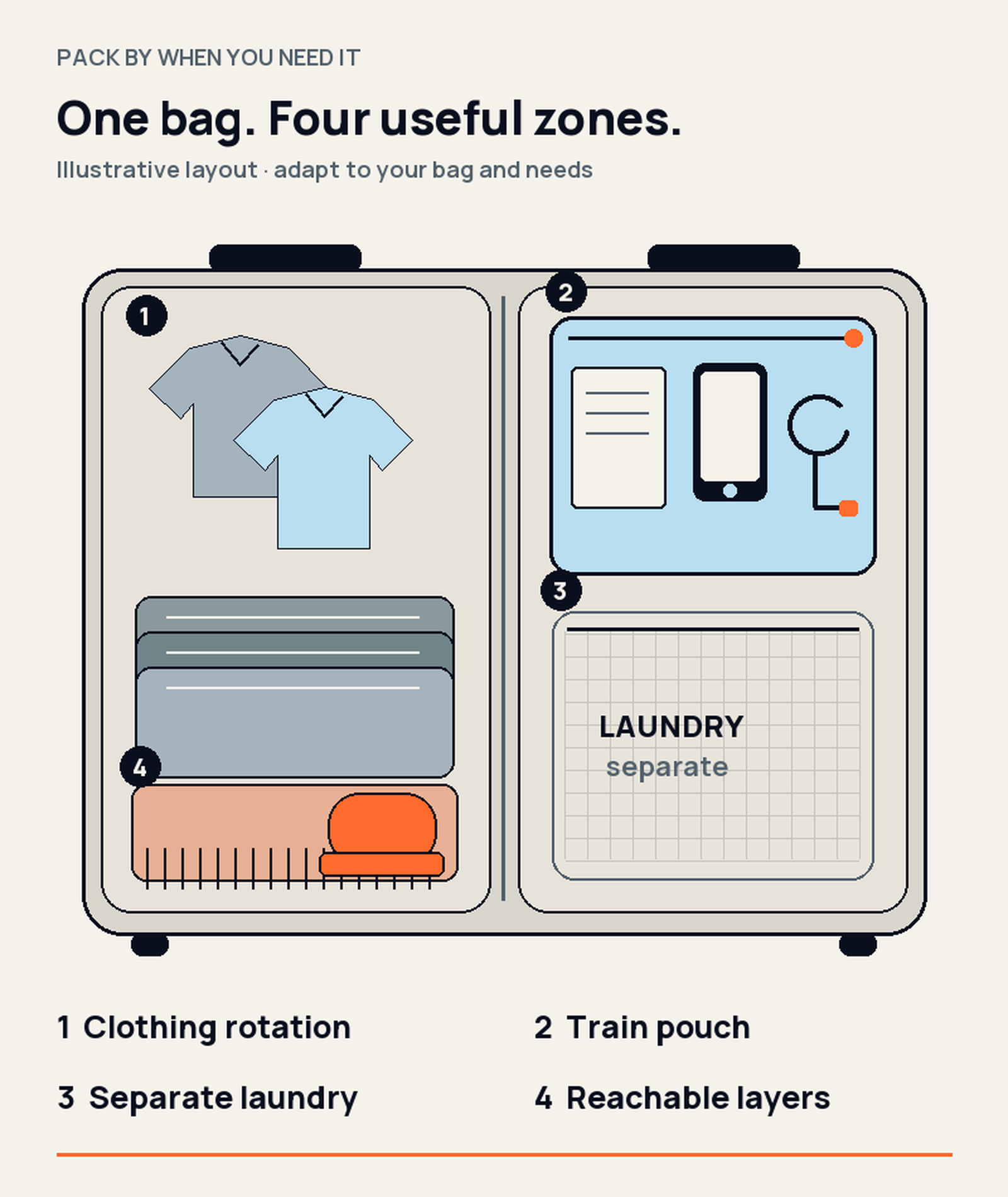
- Documents: the identity or travel document required for your journey, ticket or pass, and any separate reservation or relevant discount proof. Keep the actual documents; a photograph is not automatically an accepted substitute.
- Journey information: accommodation address, arrival instructions and useful contact details saved somewhere accessible. Download documents that support offline use, and check how your particular ticket or pass must be displayed.
- On-train essentials: phone, suitable charging cable, personal essentials, water and a practical snack. A power bank can be useful if compatible and permitted; do not assume a working socket at your seat.
- For leaving the train: hat, gloves and rain protection near the top, rather than underneath the entire clothing stack.
With Interrail, a saved journey, a valid pass ticket and a seat reservation can be different things. Use our seat-reservation guide to check what your chosen train requires. Packing the right bag does not replace having the right travel documents.
6. Check the rules of the train you will actually use
Interrail is a pass, not a Europe-wide luggage allowance. Check each operating company and service, including any flight, coach or replacement transport in the journey. Measure the packed bag when dimensions apply; allow for wheels, handles and external pockets as the operator specifies.
| Official example | What the operator says | What to do with that information |
|---|---|---|
| DB long-distance trains | DB allows hand luggage plus one larger item that one person can carry. Its guidance describes several storage locations and requires access routes to stay clear. | Choose a load you can manage and stow appropriately. Check additional rules for your international service. DB luggage guidance. |
| TGV INOUI | The published allowance is up to two labelled bags, each at most 70 × 90 × 50 cm, plus one labelled hand-luggage item at most 40 × 30 × 15 cm. | This is a maximum allowance, not a packing target. Check the exact service and special-item rules. TGV INOUI guidance. |
These examples were checked on 14 October 2026. They do not establish the rules for OUIGO, another operator or every international partnership. Recheck before departure, particularly if you change trains or add a large or special item.
On board, use the designated luggage space and follow the crew’s instructions. Keep doors, aisles, emergency equipment and wheelchair spaces clear. Do not occupy another seat with your bag. Keep important documents and valuables accessible to you, and supervise your belongings; no packing arrangement guarantees against loss or theft.
7. Try the whole setup before departure
Fill the bag as you intend to travel, including the small bag, coat and normal travel-day extras. Then rehearse a manageable version of your actual journey. You do not need to recreate a train step or lift a heavy bag overhead to prove anything.
- Move: roll or carry the full setup over a relevant distance. Can you steer it, stop and turn without repeatedly rearranging everything?
- Reach: take out your phone, travel documents and rain layer without spreading your belongings across the floor.
- Stow: check the likely storage arrangements for your train. If lifting is a problem, investigate suitable storage and assistance rather than attempting an unsafe test.
- Repack: remove your coat and then put it away. Can you close the bag with the clothes folded normally, not only with perfect home packing?
If the setup does not work, remove an item with no clear use, reduce duplicate clothing or reconsider the bag and transfer plan. Allow the connection time you actually need. Keep essential equipment and access needs in the plan; they are not optional extras to discard for a smaller-looking suitcase.
Before you zip it up
- The clothing covers the forecast and activities on my actual route.
- I have counted what I wear as well as what I pack.
- My laundry stop includes access, drying time and a fallback.
- My ticket or pass, reservations and required documents are reachable.
- I can manage the complete setup, or have confirmed the help I need.
- The bag meets each relevant operator’s current rules.
- I have room for removed layers and ordinary travel-day extras.
Frequently asked questions
Is a backpack better than a suitcase for Interrail?
Not universally. Choose around your ability and preference to carry or roll a load, the surfaces and distances on your transfers, and the storage on your trains. Test the actual packed setup.
What is the maximum luggage weight for Interrail?
There is no single answer for every participating operator and service. Check the rules of each train. A bag meeting a published allowance still needs to be manageable in your travel arrangement.
Can I use the same list for ten days without washing?
Not unchanged. This example depends on a day-four wash. Without it, increase the clothing rotation or organise another realistic laundry opportunity before deciding what to leave out.
Sources and update notes
Photo: SHVETS production / Pexels, cropped and compressed under the Pexels licence. Illustrative packing photograph, not the complete winter kit above. Bag diagram: Rail Trip Planner.
A route that works with your luggage
The transfers, stays and pace of a trip matter as much as the packing list. Rail Trip Planner creates a personalised itinerary PDF and matching trip map for €29 per itinerary. You book transport, accommodation and activities directly with the providers.
 Christmas and New Year rail travel
 Keep the scenic stretch in daylight
 Seat reservations: the practical checks