
Interrail Pass vs Individual Tickets: How to Compare a Trip with Few Train Days
Short answer: if you have only a few intercity train days and your dates are fixed, price individual tickets first. Then compare that total with a suitable Interrail Pass, its reservations and any journeys you would still need to pay for. A pass can be worthwhile for flexibility or additional travel, but the number of holiday days alone does not tell you whether it saves money.
A twelve-day trip with long stays in three cities is a different purchase from twelve days of moving between destinations. This guide helps you make the comparison using your actual route, without assuming that either option always wins.
On this page: Count your train days · Compare the full cost · A 12-day route example · Check flexibility · Before you buy · FAQs
1. Count train days, not nights away
Start with a list of the journeys you actually intend to take. Include rail day trips and the beginning and end of your journey, where relevant. Keep sightseeing days separate. A day spent walking around Paris does not become a pass travel day simply because you are on an Interrail-style holiday.
On a Flexi Pass, travel days sit within a wider validity period. Several eligible trains used during one travel day do not automatically consume several days. Interrail defines a mobile pass travel day as midnight to 23:59 local time. Overnight trains require a separate check of the applicable rules. Check the official travel-day explanation.
Do not assume every metro, bus, mountain railway or excursion is covered. Check the participating operator and the exact service. If a journey is only discounted, record the amount you still need to pay. Your country of residence can also affect use of the pass at home. Check current Global Pass conditions.
2. Compare the complete price of both options
Use the same dates, route, class and passenger details for both searches. Compare prices per person first, then calculate the group total. Record when you checked them: a fare found last month is not a reliable comparison with today’s pass price.
| Individual tickets | Interrail Pass |
|---|---|
| All tickets needed for the planned route | The suitable pass at its current purchase price |
| Mandatory seat reservations not already included in the fare | Mandatory passholder reservations and supplements |
| Booking fees and relevant extras | Booking fees and journeys outside pass coverage |
| Optional extras you actually intend to buy | Optional extras you actually intend to buy |
Ticket total = complete journey fares + reservations not already included + fees and relevant extras.
Pass total = pass price + required reservations/supplements + fees + uncovered journeys.
Avoid double-counting: if an individual ticket includes its reserved seat, do not add the passholder reservation fee on top of that ticket. Likewise, a pass reservation is not a replacement for a valid pass.
Some high-speed and night trains require a reservation in addition to the pass. Check the exact train and passholder availability before relying on it. A pass does not guarantee access to every departure; Eurostar, for example, has limited passholder seats. Read Interrail’s reservation guidance.
Reservation prices depend on the service and booking channel. Use the official international reservation-fee reference as a starting point, then check the actual booking total. Its published figures are indicative and can change.
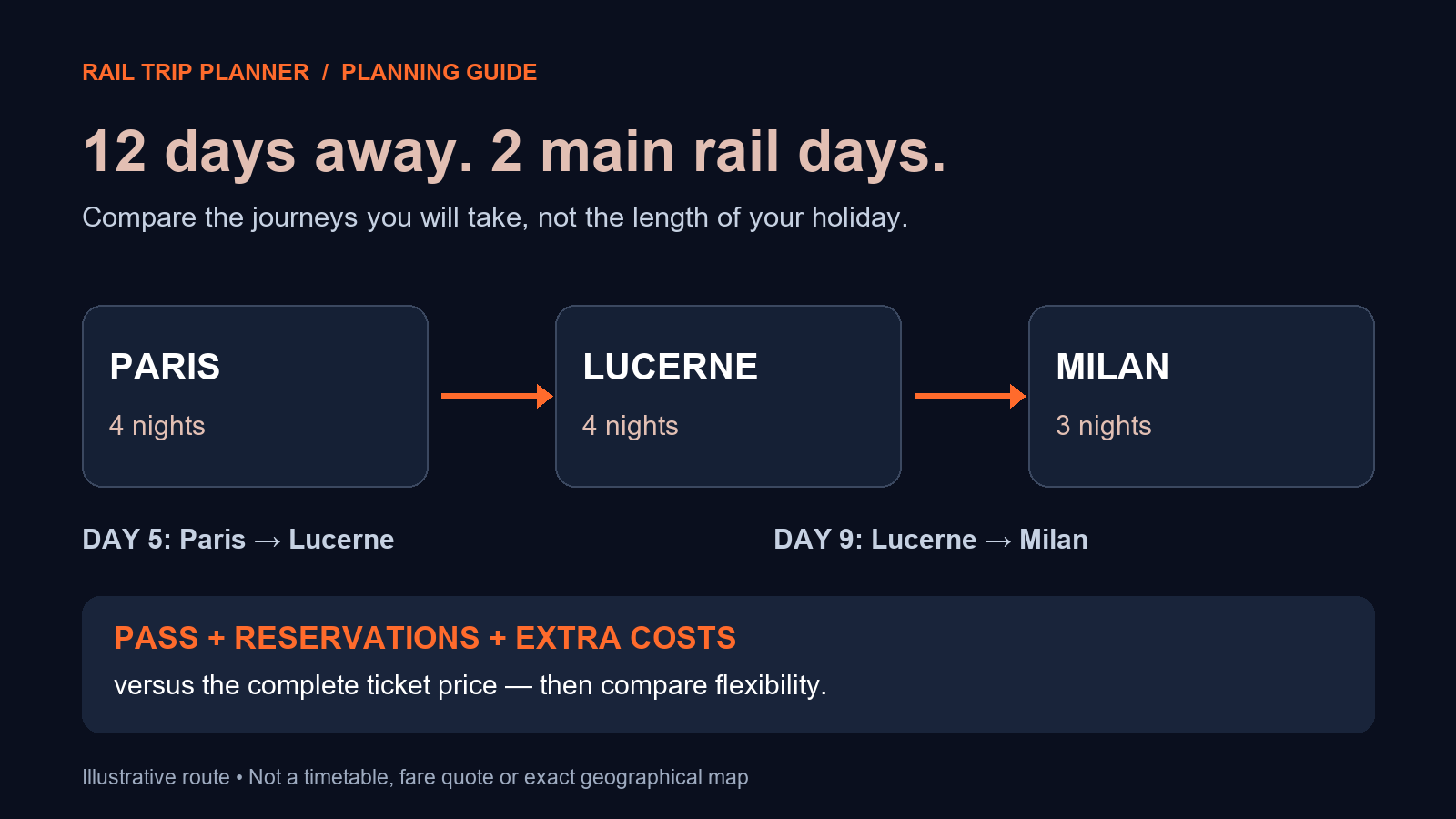
An illustrative route, not a timetable or fare quote. Count planned train days before choosing a pass.
3. Worked route: 12 days, two main rail days
Illustrative itinerary, not a dated quote: four nights in Paris, four in Lucerne and three in Milan. Arrival is in Paris; departure is from Milan. Flights and airport transfers are outside this rail comparison. No additional rail excursions are assumed.
| Day | Plan | Rail comparison |
|---|---|---|
| 1–4 | Stay in Paris | No intercity journey in the example |
| 5 | Paris → Basel → Lucerne | First main rail day; price the whole journey |
| 6–8 | Stay in Lucerne | Add rail excursions only if you intend to take them |
| 9 | Lucerne → Bellinzona → Milan, via the classic Gotthard route | Second main rail day; keep the scenic routing identical in both searches |
| 10–12 | Stay in Milan and depart | Add an onward train if it forms part of your actual trip |
That gives eleven nights and twelve holiday days, with two main intercity travel days. The changes at Basel and Bellinzona do not, by themselves, create extra pass days when the journeys take place within the same applicable travel day. Exact connections, coverage and reservations still need checking for your dates.
For this profile, our starting recommendation is to quote individual tickets first. That is a search strategy, not proof that tickets will be cheaper. Compare with a pass actually available for the traveller and validity period; do not assume you can buy precisely two days of pass travel.
For the Swiss–Italian journey, keep the desired route through the classic Gotthard mountain line in both quotes. A cheaper or faster journey through the base tunnel is a different journey. SOB’s Treno Gottardo information describes the scenic service; use a dated timetable to check the continuation to Milan.
If prices for your dates are not yet available, keep the comparison open. Do not substitute a promotional “from” fare or an unrelated departure and call it a quote for your trip. You can settle the route first and revisit the purchase when comparable offers are available.
4. A simple break-even test
Use your own live quotes in this calculation: individual-ticket total − pass total. A positive result means the pass costs less for the journeys included; a negative result means tickets cost less. It says nothing about comfort, flexibility or unplanned travel.
Arithmetic example only — these are invented numbers, not current fares: suppose the complete ticket total is €180, while a pass costs €240 and its reservations/fees add €40. The pass total is €280, so tickets are €100 cheaper. If comparable ticket quotes instead total €340, the same hypothetical pass total is €60 cheaper. Replace every number with your own quotes before deciding.
Do not assign value to unused pass days unless you genuinely want to travel on them. An extra day is useful if it supports a realistic excursion; it is not a saving if you add a trip just to use the pass.
5. Compare flexibility as carefully as price
A low ticket fare can have stricter change conditions than a more expensive fare. Individual tickets are not all equally inflexible. For example, SBB states that its Supersaver tickets are valid only on the connection selected when buying. Check the rules of the exact offer instead of applying that rule to every Swiss ticket. SBB ticket guidance.
With a pass, changing a reservation-free journey may be easier, but you still need valid travel days, coverage and time within the pass validity. A required reservation can limit last-minute changes. Read the rules of both the pass and any reservations; do not assume a promotional pass has the same refund conditions as a standard one.
- Fixed route, few transfers: individual tickets deserve the first price check, especially if you can commit to specific departures.
- More train days or uncertain plans: a pass deserves a closer look, provided its covered services and reservation availability match the route.
- A modest price difference: decide what flexibility is worth to you rather than calling the cheaper option automatically better.
6. A mixed approach can also work
You can compare a pass for the journeys where it is useful with separate tickets for short or uncovered trips. Count every purchase in the same total. Also investigate relevant local or regional products if your route is concentrated in one area, checking their coverage and conditions rather than assuming they replace an international ticket.
Avoid buying a pass first and then trying to reshape the holiday around it. Choose the route you want, then buy the transport that fits. For another route structure to compare, explore our Nordic Interrail route guide.
Before you buy: the comparison checklist
- List every planned train journey, including excursions and any onward travel.
- Count the actual pass travel days and check the suitable validity period.
- Use the same route, dates, class, ages and applicable discounts in both searches.
- Use complete checkout totals, not headline “from” prices.
- Check mandatory reservations, supplements and passholder availability.
- Check uncovered transport and any restrictions in your country of residence.
- Read change, cancellation and refund conditions for the exact products.
- Record the quotes and consultation date; recheck before paying.
Frequently asked questions
Is Interrail always cheaper than individual tickets?
No. The answer depends on the journeys, current fares, pass price, reservations and the flexibility you need. Compare complete totals for the same trip.
Does a twelve-day holiday need a twelve-day pass?
Not necessarily. Count the days when you will use covered trains. In the example above, the main route uses two rail days, even though the holiday lasts twelve days.
Are seat reservations included in the pass?
Some trains need an additional paid reservation. Check each service before buying; do not treat the pass price as the complete rail cost.
Can I decide without exact travel dates?
You can shortlist routes and compare product conditions, but you cannot establish a reliable fare winner without comparable offers. Keep prices labelled as provisional until then.
Sources and update notes
Prepared by Rail Trip Planner. Official information checked on 1 October 2026. This guide explains a comparison method; it does not quote May 2027 availability or guarantee savings. Check the linked operators and Interrail before purchasing.
Key references: travel days, Global Pass conditions, seat reservations, international reservation fees, SBB tickets and SOB Treno Gottardo.
Want a route that fits your dates and budget?
Get a personalised rail itinerary in PDF and a Google My Maps map with your recommendations. €29 per itinerary. You make the bookings directly.
Get My Custom Plan — €29 Seat reservations: the practical checks
 When train tickets are not on sale yet
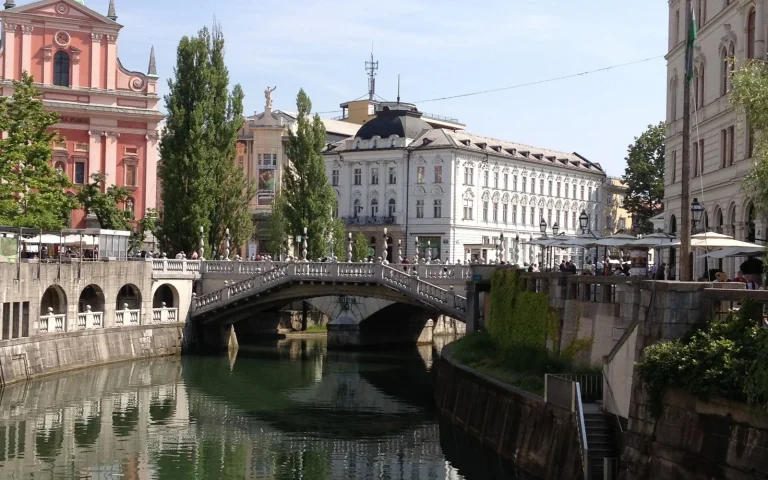 Munich to Venice via Salzburg and Ljubljana